Thursday, 25 June 2015

Seattle and New York - USA ports announced

Thursday 25th June and Clipper have announced that we will be visiting Seattle and New York.

Seattle, Washington State
'Today we are very pleased to announce that the race will stop in Seattle, USA, in April 2016 for the first time in our ten edition history.

Following the epic race across the mighty Pacific Ocean, Leg 6 crew will be welcomed into the city’s Bell Harbor Marina in mid-April 2016, and Leg 7 crew members will kick start their American Coast to Coast adventure there later that month.

Seattle is in Washington State, positioned on Puget Sound in the Pacific Northwest, and is known as the Emerald City as it is surrounded by natural beauty which encompasses the ocean, mountains, evergreen forests and thousands of acres of parkland. Fans of the TV series such as Frasier and The Killing to name a few will recognise its futuristic Space Needle, a legacy of the 1962 World Fair and the city’s most recognisable landmark.

The Leg 6 stopover will last approximately ten days before Leg 7 departs, which we can also confirm will once again finish in New York.'


Orca Whale in Puget Sound


I am hoping that there will be time to explore the area surrounding Seattle including whale watching in Puget Sound.  I have always wanted to visit this part of North America and hope that we will have time off the boat to do some sight seeing.


Some wonderful sea life waiting to be discovered!!


Then sailing into New York....     

I am hoping that Becca and Tom might come and visit me in New York for a few days.  Not too far to travel and Becca will probably have finished her degree by then.

UNICEF - Sponsor announced

We found out last week that our team sponsor is UNICEF !!


Our boat in Gosport Marina
This 15-16 race is the tenth to be held and Clipper have donated the boat to UNICEF, the official race charity, and our team, 'Team Jim', have the honour of sailing round the world in her.

The boat is going to be officially named on August 24th at St Katharine's docks. 

If you would like to help me to raise money for UNICEF then please go to the following link:
https://www.justgiving.com/Kate-Whyatt1 


Some of 'Team UNICEF' at the crew team building weekend

Monday, 15 June 2015

Roles on Board


Three of the Clipper 70s battling it out

So, what does it take to race one of these yachts 40,000 + miles around the world?  Lots and lots of organisation and a good team.


As well as crew who will sail the boat, pull the sheets, change the sails, and pack the spinnaker we need a number of other people who are willing to put in that little bit extra on top of everything else.

The 'Nav' Station
Chief Engineer (CE): This person is responsible, under the skipper's supervision, for maintaining all on board mechanical, electrical and plumbing systems in a fully working condition including routine servicing.  It will involve making sure the engine and generator are in fully functioning mode, as well as the entire electrical system on the boat - lights, navigation station (nav station), steaming lights, communications equipment etc.  All the plumbing has to function properly and this includes the water maker, heads and showers, fresh water system including the water heater, grey and black water systems and the bilge and fire pump systems.  Different colour water!  What's that all about?  Grey water is from the showers and sinks, including the galley, and the black water is from the heads.  And probably one of the worst jobs on the boat will be to unblock the 'heads' if, and let's hope they don't, they get blocked.  Could be a very messy and smelly job!

The CE has to organise all the routine maintenance and cleaning of these systems at the stop over ports as well as making sure there are sufficient tools and spare parts on the boat prior to sailing.  An enormous task which is carried out with the help of one or more Assistant Engineers.

Medic:  A suitably qualified person is nominated as the 'Ships Doctor' and in our case we have a retired GP, Peter, who is sailing around the world.  Together with Jim, our skipper, and a shore based team, Peter will make sure that any medical issues are correctly dealt with including the management and organisation of the medical supplies.   Jim remains responsible overall for all medical issues, but Peter will run the day to day medical aspects and make sure the kit is maintained as well as ensuring there is a suitable medical history for all the crew.  I sincerely hope that all Peter has to do is hand out sea-sickness tablets!

 Media Director:  We will need someone to oversee and organise all the media output for our boat though all the crew will share the media workload.  This will involve writing blogs, taking photos and videos and making sure that the media requirements for the boat are completed in a timely manner and to a high standard.  We will have two people, Henry and David, attending the training, with Henry (RTW) overseeing all the on board activities and David (Leg 7), with all his media experience, being our on shore guru.


Mending sails down below
Sail Repairer:  This is a vital role as it is the condition of the sails that will play a big part in determining how well we do on the race.  Two of our RTWs, Henry and Peter, will be doing the training for this.  Peter can already sew up people so is happy to learn to sew sails - I wonder if there are any similarities.

Sail repair will be carried out down below and with badly torn sails can take as long as 24 hours of continuous work.  Clipper kindly give us a heavy duty sewing machine so not all is done by hand.  As well as Peter and Henry there are other 'leggers' who have offered to help in this quarter.  Not sure if it is something I fancy doing as the boat rocks from side to side.

Treasurer and Quarter Master:  This person is responsible for managing the crew fund and buying all the extra bits of kit and equipment that we feel is necessary.  Nothing bought must improve the performance of the boat but we are allowed things that help make life more manageable and comfortable.  For example our first purchase has been two fridge/freezers that will make our meals a little more interesting for the first few weeks.  Chloe (RTW) has the enormous task of trying to get extra funds from people and also coordinating all the various lists of what people think is necessary.

Chief Victualler (Queen Mother):   The most important crew position on the yacht which carries an enormous amount of responsibility.  The role of the CV is to ensure that all the correct supplies are purchased and loaded on board before the start of each race.  Janice (RTW) is responsible for organising the menus for all on board, buying sufficient food supplies for each leg, managing the menu, managing the storage of all ships stores, tracking the usage of stores and stock taking, replenishing stores when required.  Janice will do this with a team of assistants as well as managing the food spending account on behalf of Jim.

Food is one of the most important aspects of this type of sailing as the last thing anyone wants is to come off watch to find a cold plate of unappetising food presented to them.  It will be difficult when the weather is rough to serve up a gourmet meal but I think simplicity and flavour have to be two of the more important elements.  We also have to take into account food allergies and intolerances - so extremely complex.  I believe that we will each need around 4000-5000 calories per day if we are to function in an optimum way so I expect we will be eating lots of pasta, rice and potatoes!


Bob the MOB dummy tied on at the stern
Safety Officer:  Howard will be making sure that all the safety equipment is on board before each race and that it is checked and maintained in an appropriate way.  He will also have to ensure that we are all kept up to date with our training eg. fire drill practice, MOB recovery etc. and that all new crew joining the boat are fully briefed on the operation of safety equipment and are familiar with drills.

Bob, our MOB dummy is tied onto the pushpit (at the other end of the boat to the pulpit) and travels around the world with us.   This means that every time a new set of crew joins the boat we can practice picking someone out of the sea.


The top of the mast needs checking
on a regular basis
Bosun:  This person is responsible for the all the maintenance, care and repair of all sailing related deck equipment including sails, rigging, winches, halyards, sheets, blocks, dinghy............ etc.  The list goes on and on.  He/she is responsible for organising the repairs and maintenance pre start, during each leg and at each stopover port, and for making sure that there are sufficient spares and tools carried on board and topped up when necessary.  Henry is doing the short training for this but will be supported by many other crew members who will also be repairing and checking sails, servicing winches and carrying out other sailing related tasks.


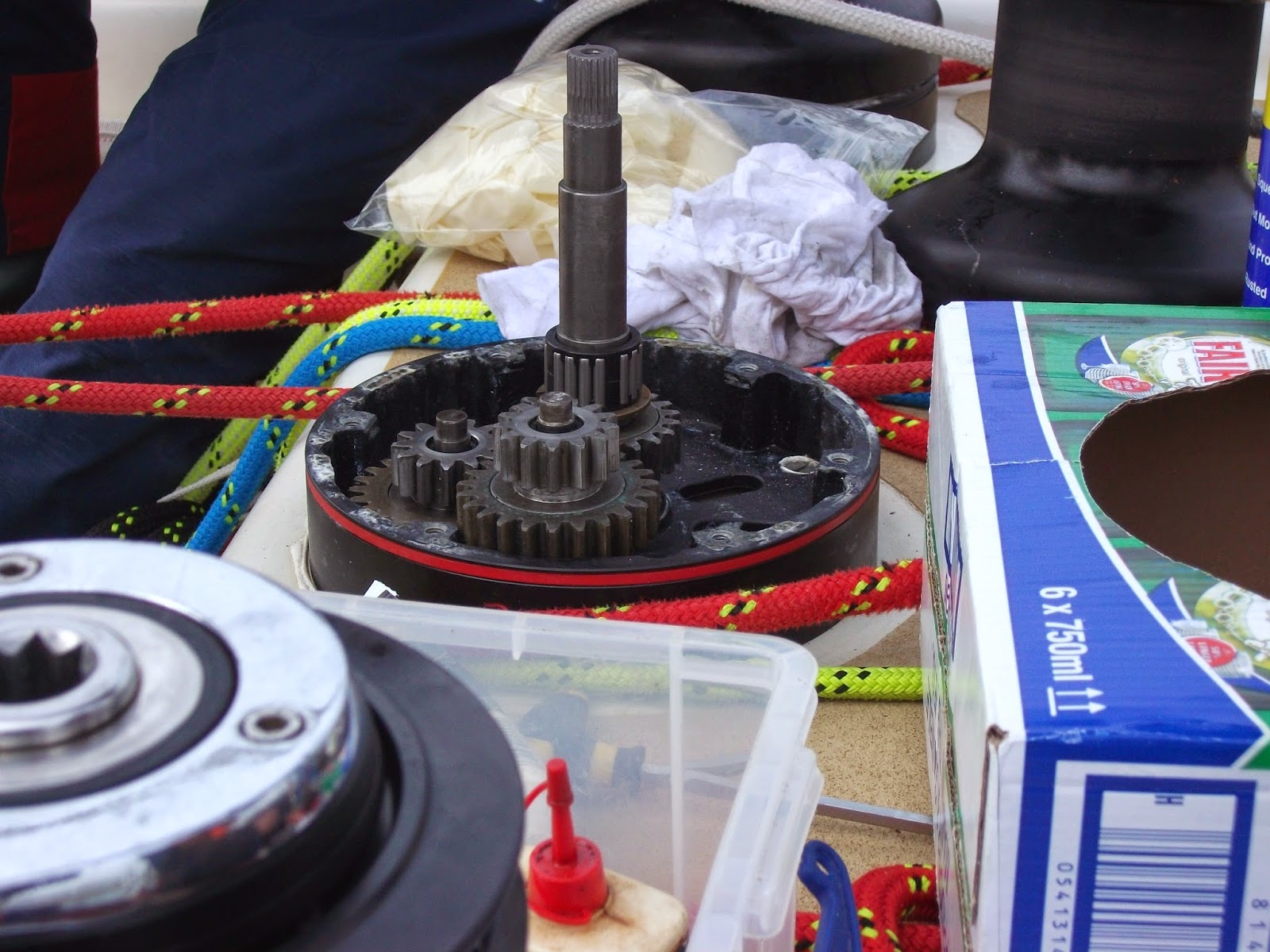
A winch being serviced
Just make sure there are no bits left in the pot
once everything has been put back together!
 
Someone will have to go up the
mast on a regular basis to check
there is no undue wear and tear


Stopover Manager:  This person will be working with our Skipper, Jim, and the Team Coordinator to manage the day to day activities that are necessary during each of the stopovers.
 
The stopovers are divided into three discrete parts to ensure that we get the most out of our time while docked.
  • The first part - involves the dreaded 'deep clean', routine maintenance and the repair of any broken items.
  • The second part - we should be able to have this time off providing there are no serious issues or 'Corporate Days'.  Corporate Days involve entertaining and taking for a sail those sponsors that are in port.
  • The third part - all meet back on the boat, meet the new 'leggers', clean and tidy the boat, sort out any outstanding issues, victual, crew training and leg planning.
The different parts are not necessarily equal in time and if more work has to be done on the boat then we will have to do that rather than take time off.  As Jim says, "If the boat isn't ready for the start then we will pay for it in the next leg".
 
Other jobs:  On top of those jobs listed above we also need someone to be involved with the IT/Communications on the boat, a Social Secretary who is prepared to organise all the crew social events, crew parties and crew clothing etc, and someone who can be our Shore Support while the rest of us are racing around the world.
 
What am I doing you might well ask?
 
Team Coordinator:  This is me.  Responsible for the majority of administration related to running a race yacht and, in Jim's words, "Organising the Skipper!"
 
As I am finding out it is a big role but I am enjoying every minute of it, and why I put my name forward is a mystery, but I did.  So far all the major roles on board have been allocated and training dates set and attendance agreed.  I am now sorting out who will be available for the two Boat 'Prep' weeks and for the delivery from Gosport to St Kat's in mid August, as well as helping Jim to sort out the agenda for the crew weekend and Janice with the victualing for our camping trip.  I can see an enormous Sainsbury's shop looming on the horizon before pitching my tent in a field near Blandford Forum in the depths of Dorset. 
The campsite
A sloping field but not as sloping as the
30 degrees we need to get used to!
I am constantly answering emails, have now become quite adept at facebook - though did send a confidential document to the wrong facebook group (oops) - and have just signed up for What'sApp with the help of Rebecca.

Ruffled feathers need to be smoothed and we have already had a bit of 'Storming' in our group dynamics.  I am hoping to write something about group dynamics in our next newsletter so that we can all understand what is normal in groups, especially those that are constantly changing as ours will be for each Leg.  There a total of 56 crew members, plus Jim, so many different relationships to manage - hopefully this is where my counselling training will kick in! 

Enough for now!

The next big 'excitement' is the announcement of our boat sponsor on the 18th and then the crew weekend over the 20th to 21st June - there are about 24 of us going so should be great fun.


This is what it's all about
Teamwork


Monday, 1 June 2015

Level 3 Sailing

So what was the sailing like on Level 3?

The training started with a very long day in the classroom going over Offshore Safety - what to do and what not to do out on the 'ocean deep' - when to launch a liferaft, which ones and how to use flares, winch safety, emergency beacons... etc. etc.    Not very inspiring but something that has to be done.  All these trainers keep telling us that the training Clipper gives us is excellent and that we are some of the best prepared crew around - so it is all worth listening too.

I arrived at the boat that evening to find that I already knew a couple of others from my Level 1 training and that there were 3 of us all in 'Team Jim' together.  Both skipper and mate were called Paul so that could either be very convenient and one just shouted 'Paul', or totally inconvenient if there was a reason to distinguish them from each other.

This boat was a Clipper 70 - only a couple of feet longer than the 68 but a different shape altogether.  The sheets (ropes) all seemed much thicker and heavier and the deck was laid out in a very different way.  Preferable, I think, as there seemed to be less clutter around and the 'snake pit', where all the ropes lead into, was closer and better connected to the cockpit.  Easier to get to and easier to communicate with.  One of the difficulties for crews new to sailing is that there are so many new words to learn.  A rope can be called many different things, all dependent on their purpose, so can change names from one hour to the next.  Very confusing!!

Sheet - pulls sails in and out
Halyard - pulls sails up and down
Line - used for something else eg. mooring line to tie the boat to the pontoon
Lazy sheets and working sheets - depending on whether there is any load on them.  The lazy one is doing nothing.

A view of the 'grinders' from the
companionway
There are also different roles for all the crew eg:

Sweater - sweats (pulls) the sails up by hand
Grinder - grinds the sails up using the 'coffee grinder' connected to the primary winch -
Mother - does all the cooking and cleaning for the day -

and so it goes on.  Totally another language and when I have sailed in the past I have heard people say - 'can you pull the thingy over there', and everything becomes a 'thingy'.  Not sure if that would be accepted on a Clipper boat though.

Sailing around the Isle of Wight
just to the south of The Needles
One of the main training elements on Level 3 was learning how to fly the asymmetric spinnaker.  These sails are enormous (330 m sq or 3,556 feet sq) and enable to boats to sail up to 30 mph going downwind in the Southern Ocean.  Unfortunately our week didn't go well in this respect.  The first time we wanted to fly it was during our circumnavigation of the Isle of Wight, but, when it came to hoisting the sail the winches got jammed so we couldn't use it.  The winch was stripped down as we bumbled along but by the time it was put back together again it was too late.


Starboard watch
Thom, Ant, Tom
Me, Mel, Dhruv
So more days were spent in the Solent - tacking and gybing.  We were split into two watches, starboard and port, and we each took it in turns to do various evolutions including changing sails, MOB (man over board) drills, hoisting and reefing etc.  Dhruv was very disappointed to discover, after he'd offered to do the MOB drill, that he wasn't going to be the casualty but the swimmer who was doing the rescue.  I think he must have fancied a 'dip' in the sea.  Instead he was dangled on the end of a rope and lowered unceremoniously down to the water to rescue 'Bob' the MOB dummy.


'Bob' the MOB dummy tied onto the stern
as we sail across the sea whipped up by the wind
With the winches fixed we headed out into the Solent and English Channel again to sail under the spinnaker.  The winds were much stronger than expected but were due to drop during the day.  We headed south east but rather than quietening down we were sailing in F7/8, a near gale - so yet again no spinnaker.  The boat crashed into the waves as we rocked from side to side, it heeled over so that the guard rail went into the water - and it was great fun.


Heeled over and heading upwind


I hadn't had a chance to helm earlier in the week, and to be honest I was waiting to drive with the spinnaker up.  My chance came, not with the spinnaker but in 30-35 knot winds and heeled right over.  I was at the helm for about 2 - 2 1/2 hours and loved every minute of it.  It was hard work, and standing could be quite a challenge when the boat was leaning right over but I think I must have had a smile on my face the whole time.  Over the past few months I have wondered if I was doing the right thing by taking off for a year to sail around the world.  At the end of this day I knew I had made the right decision.  The seas weren't as big as they are going to be in the Southern Ocean or across the North Pacific, but the feel of the wind in my face as I steered through the waves was magic.  I loved it!!


Sailing through the Solent
It's very difficult to know what's vertical/horizontal on
a boat that is always tipping from side to side.
We eventually did get the spinnaker hoisted and dropped, in the dark, on the last day but it was disappointing not to have had a chance to sail with it up for a decent amount of time.  It just means that when I go onto Level 4 in early July that there will be a gap in my knowledge, but I'm sure I will have many chances to fly it over the next year or so.  We didn't get a chance to pack the spinnaker away that evening but spent about 1 - 1 1/2 hours the following morning trying to sort it, tie it in bits of wool and re-pack it.  Not a job that I fancy doing downstairs as the boat rocks from side to side.


Just one more week of sailing training left now and then I am supposed to be able to sail off around the world.  Luckily there will be 20 other people on board so we can share the responsibility.

As I write this I still haven't exchanged contracts on the house.  Time is getting short as this time in three months I will have left the UK and will be on my way to Rio.  We will hopefully be moving in early July and I suppose that if not all boxes are unpacked before I leave then does it really matter.  It will give Tom and Rebecca something to do while I'm away and the worst that can happen is that I will have to empty boxes when I get back.

I am putting up all my photos in a flickr account and do follow this link if you would like to see them.  A bit repetitive at the moment but one day I hope to sort them out.

https://flic.kr/s/aHskcd9dWv


'Chilling out' in the snake pit, safely tied on!


Monday, 25 May 2015

Life on board a Clipper 70

I have just returned from my L3 training, the first time on the 70 ft Clipper yacht, one of the boats I will be going around the world on.  Slightly different to the Clipper 68 in that below decks is set out differently and on deck is less cluttered, mainly because the 70 doesn't have the spinnaker pole as we will be using an asymmetric.  I thought I'd give people an idea of what it is like on the boat, so here goes:                                                               

Accommodation

Accommodation is just as basic as on the 68 though my bunk was a bit like a cave - very dark and not very high.  The only way I could get into bed was to wriggle into my sleeping bag while standing on the floor, then sit on the side of the bunk all scrunched up before lying down and lifting my feet onto the bunk.  Someone said it was the funniest thing they'd seen for a long time.  Once in it was cosy and I felt safe, and I imagine that in an ocean swell with huge waves there is not much space to be thrown around.  I didn't have any lockers so had to leave my stuff on the other side of the gangway under the bunks there.  Not sure it will be my favourite spot while we are racing but I believe that bunks are going to be allocated by drawing lots out of a hat so I might not have much choice.  I think we'll be 'hot bunking' anyway so I may well sleep somewhere different each time I put my head down.


The 'Heads'
The 'heads' (toilet) are even more basic with a hand held shower and bowl with no lid.  I can imagine having a shower will be something that is not done very often as water will be salty and it will take ages to clean up afterwards.  Everyone has to sit, including the boys, and they have to be left as found.  It is quite an achievement to be able to balance as the boat heels over at 30 degrees, and if those on deck suddenly decide to tack it can be quite a challenge to stay sitting as the boat is 'flung' the other way.  There are two of these delightful 'rooms', divided off from the rest of the boat by a flimsy zipped canvas door.


The Galley
The galley is positioned in the centre of the boat at the bottom of the companionway up onto deck.  A reasonably equipped and compact space with everything tidied away in cupboards with no doors.  A decent hob with five gas rings and a small oven and grill so, as long as the seas aren't too rough, some decent meals can be served up.  We will each take it in turns to be on 'mother watch' for a day during which time we are responsible for all meals and cleaning.  Mother watch lasts for 24 hours so also gives crew a chance to have a longer sleep, do washing, have a shower and generally chill out.  I can't say I am particularly looking forward to having to spend my time below decks but hopefully seasickness will become a thing of the past as my brain gets used to seeing and feeling contradictory experiences.

Inside the sail locker looking down through the hatch from the deck


Unlike on the Clipper 68 where we slept in the sail locker the 70 has a separate sail locker in the bows.  It means that we won't be soaked every time the hatch is opened to either take up or bring down a sail.  There are bunks in this very basic space and I expect that if the boat has a full complement of 22 crew on board then people may have to sleep there.  Not sure.  This picture is of Mel (another Team Jim crew member) and I after we had repacked the locker after the final day deep clean.  It doesn't always look this tidy!

Floor boards removed and bilges cleaned
and wiped down


 At the end of the training week, and every time we finish a race, we have to do a 'deep clean'.  This involves taking everything out of the boat, including all our personal belongings, and wiping everything down with anti-bac (anti-bacterial spray) including cushions, mattresses, all lockers and bilges.  Floor boards are taken up and washed down on the pontoon, foul weather gear and all the lines and sheets (ropes) are hosed down with fresh water.  Once everything has been put back the decks are washed down and tidied up.
Washing under the 'cuddy'

This is also a time for maintenance including servicing the winches and repairing lines.  Time in port at the end of each race will include all this maintenance and it is not until that has been completed that we will be able to have some time off.


Will I remember which bit goes where?


Sophie has become a good pal since we met on Level 1 just after Easter.  She is also RTW (round the worlder) but on Qingdao, the boat sponsored by the city that held the sailing events in the Beijing Olympics.  The plan at the moment is to get together on our stopovers - it will be good to see a different face and to be able to download after an intense few weeks at sea.


Sophie splicing a sheet that had become frayed and
in danger of falling apart.
Living is going to be interesting.  It's OK for a
few days when it's possible to go ashore for a shower but for 5 weeks without a break - a totally different 'kettle of fish'.  I can imagine resentments growing if someone is perceived not to be pulling their weight, or, for example, if they have taken one too many biscuits.  I am hoping that this is where my skills as a listener will come in, and that I am able to give people the space to be heard in a non-judgemental and empathic way.

The next time on a boat will be in early July when I will be training with my Skipper, Jim, and with others from my boat.  I am looking forward to it.


Looking west as we sailed down the Solent and back to Gosport


Friday, 8 May 2015

Crew Allocation and start port

A good day yesterday when we found out that we will be leaving from St Katherine's Docks on the 30th August. Also I
am on 'Team Jim' and will be finding out our boat sponsor when that has been sorted.

Seems like a good crew and I am really pleased to have Jim as skipper.  Two others from my Level 1 Training and one person from Frensham Sailing Club so not all unknown.  The race has really started!!

Now on L2 training which began with Sea Survival today and will continue with offshore life when we set sail tomorrow.  A real mix of crew including 3 from China, 4 from South Africa, 2 from France and me. Skipper from Canada and his mate from Liverpool - so an international feel.

Will let you know how the week went, but I'm hoping for good winds to take us west along the south coast and back.

 
'Team Jim' on the steps of Portsmouth Guildhall just after Crew Allocation


Living on Board with Level 2

The idea of Level 2 training is to get an understanding of what it is like living on board 24/7 in a watch system - cooking, cleaning, sailing, sleeping, engine checking, sleeping, being seasick, helming, sleeping, nausea ......... etc. 

The day after Crew Allocation I reported to a school swimming pool in Gosport where 20 of us were doing our sea survival training.  We spent the morning going through the theory of surviving if tossed overboard, abandoning into a life raft or staying with the boat.  A charismatic guy brought life to what could have been a very boring session but turned out to be quite interesting, before we all headed for the swimming pool to put into practice some of the things we had talked about in the morning.  We jumped into the pool, clambered into a life raft, formed a 'snake' to get from one end of the pool to the other, raced, shouted, swam, had buckets of water thrown at us - simulation of the Pacific Ocean I think,  and generally had a laugh.  A good way to start to get to know the crew we would be spending the next few days with.


'The Crew'

It was then onto the boat, CV9, with nine others plus skipper and mate, for the sailing part of the training.  The crew was an eclectic mix of Chinese, French, South Africans, Dutch and a smattering of Brits, which made for some interesting discussions and cultural exchanges.  Most of us succumbed to a bout of seasickness with some of the younger South Africans taking to their bunks for a significant part of the time.  Considering some of them couldn't swim and had probably never seen the sea before they generally made a stirling effort to take part.

Sunset over the Isle of Wight from the English Channel


The idea was to head west down towards Portland but the exceptionally cold wind for the time of year, from the north and west, meant that we headed south across the Channel to France instead.  We witnessed a couple of stunning sunsets, one across to the Isle of Wight and the other as we headed towards the French coast, which made the crossing bearable. 


Evening sky as we head towards the French coast east of the
Cherbourg Peninsular

It was lovely watching the sky get darker and for the moon to rise into a star studded sky, while the lights on fishing boats, tankers and cruise liners blinked and sparkled across the black sea.  To say that I am excited about crossing some of the most inhospitable oceans in the world is an understatement.  I can't wait to experience the night skies and sunsets, to watch the changing colour of the sea as day turns to night and back again, to see the sun set and moon rise, though not necessarily in that order, and to experience the sounds of the water as we slice our way from one continent to another.


         What was it like living on board?  For the first two and a half days I was feeling nauseous and was sea sick.  I did wonder what on earth I had signed up for and was I making an enormous mistake.  Kees (pronounced Case), our skipper, took part in the 13-14 race and tried to convince us that the nauseous feeling goes after 2-3 days as the body starts to ignore the sensations created by the fluids in the inner ear. Unfortunately we didn't stay offshore for more than 2 1/2 days so his theory was never fully tested.  I did manage to get out of my bunk and onto deck for my watches, but because I didn't eat properly for 48 hours I started to feel very weak, tired and dizzy.  Kees made the decision to go back to Gosport as, at times, there weren't enough crew on deck to practice sail changes, reefing etc.  A good decision though I would have like to have stayed out for a further 24 hours.  We had fulfilled the brief - got a good idea of what it was like to live offshore and to function within a watch system.


Is anything vertical?  The cooker certainly doesn't
seem to think so.
We all took it in turns to be on Mother Watch - to cook and clean - and it was an interesting experience heating up baked beans and pasties while the boat tacked from side to side.  The cooker was on gimbals but never seemed to sit in an horizontal position - or perhaps I was never in a vertical position to judge.  I would be leaning one way only to find that my world tipped and I was then leaning the other. 
 
Getting in and out of my bunk was challenging, as was going to the loo.  If there was a clatter up above it probably meant we were about to tack so 'brace..brace..brace' as the boat rocked through 90 degrees.  Sleeping wasn't too bad and I managed to get to sleep quite quickly.  There was the 'snoring orchestra' in concert most nights but the sound of the water on the hull as the boat travelled through the water was loud, but comforting at the same time.  The boat slamming into the waves wasn't too much of a problem for me but then I have had many years of training as I slept in large dormitories in various boarding schools as I grew up.

The view behind


Our last day of training was spent sailing up and down the Solent practicing the evolutions we hadn't been able to do during the preceding days due to low watch numbers. Tacking, gybing, putting in reefs, shaking out reefs, man over board drills, lowering and raising headsails, driving, knot tying practice, were all gone through in fine detail until we had it sussed.  I have to say, training is hard work, especially when it is cold.


Sunset over the Solent

I was sad to be returning to Gosport at the end of our last day of sailing.  I know I hadn't been well for part of the time but I had met some wonderful people from all over the world.  I have now met someone who will book me a hotel room and show me round Quindao when I get there in March 2016.  I have cooked and cleaned with young South Africans who are about to embark on their journeys of a lifetime as they are each sponsored for one leg of the race.  I have heard and taken onboard advice given by the skipper who took part in the race a couple of years ago and I have learned a little more about living and sailing on an ocean racing yacht.


The deep clean of floor boards
The last morning was spent deep cleaning the boat.  This involves cleaning everything from the bilges to the galley and heads, from the mattresses and cushions to the floor boards.  I was on floor boards which entailed taking all the boards off the boat, washing both tops and underneaths with Milton, drying them and trying to put them back in the same order and place they came out from.  Luckily some of the younger guys had technical backgrounds so could solve the puzzle as they were presented with various unlabelled floor boards through various hatches in what seemed like a random order.

On reflection it was a good week, though at times I did wonder if I had done the right thing in signing up as I leant over the guard rail on the leeward side at the back of the boat.  Now that I am back home I know it is the right thing to be doing. 

My Level 3 starts next week on the 15th May with an Offshore Safety course, before we head out into the Solent again.  This time it will be on one of the 70 ft race boats so that we can practice with the asymmetric spinnaker and start thinking about race tactics.  I can't wait!!